
Rio vs Salvador Carnival — Which Should You Choose?
Rio and Salvador are not two versions of the same thing. They are fundamentally different experiences — different music, different formats, different atmospheres, and different types of traveler who love them. This guide gives you the honest comparison you need to make the right choice for your trip.

Rio Carnival — the world’s most photographed celebration, built around the Sambadrome parades and the enormous street blocos of the South Zone.
The Fundamental Difference
The most important thing to understand about Rio vs Salvador Carnival is that the question is not “which is better” — it’s “which suits the kind of experience you want.”
Rio Carnival is primarily a spectator experience. The Sambadrome parades are the centerpiece — you buy a ticket, take your seat, and watch samba schools perform for you across a 700-meter parade avenue. It’s theatrical, visually extraordinary, and organized. The street blocos add a participatory dimension but the iconic Rio Carnival image — the one you’ve seen in every travel magazine — is someone watching from the grandstands.
Salvador Carnival is entirely participatory. There is no Sambadrome, no parade avenue, no grandstands. You are in the street. The trios elétricos move through you and you move with them. 2 million people per day dance through the same circuits. The music is live, loud, and inescapable. You cannot watch Salvador Carnival — you can only be part of it.
Head-to-Head Comparison
| Category | Rio de Janeiro | Salvador |
|---|---|---|
| Format | Sambadrome parades + street blocos | Street Carnival only — trios elétricos |
| Music | Samba (parades), mixed (blocos) | Axé — distinctly Bahian |
| Experience type | Spectator (Sambadrome) + participant (blocos) | Fully participatory |
| International recognition | Most famous Carnival in the world | Known to Brazil enthusiasts, less globally |
| Cost | Higher — Sambadrome tickets + hotel premium | Lower for pipoca; higher for abadás + camarotes |
| Safety | Good in tourist areas, watch blocos | More vigilance required — theft higher in pipoca |
| Duration | 5 days official + 2 weeks of blocos | 6 days — continuous street Carnival |
| Beach access | Yes — Copacabana, Ipanema | Yes — Barra, Ondina seafront |
| Cultural depth | High — samba school competition is serious art | Very high — Afro-Brazilian roots are central |
| Flight connections | Better — more international routes | Limited — usually via São Paulo or Recife |
What Rio Does Better
The Sambadrome parades — samba schools with thousands of participants, elaborate floats, and original music competing across three nights of the Special Group competition.
- The Sambadrome is unique in the world. Nothing else in Carnival — or in live events generally — looks or feels like a Special Group parade night in Rio. The scale, the production, and the atmosphere are incomparable.
- More accessible for first-time international visitors. Better flight connections, more English spoken, more tourist infrastructure, and a more legible format for people who haven’t experienced Brazilian Carnival before.
- The street blocos of Rio are genuinely excellent. Cordão do Bola Preta, Monobloco, Simpatia é Quase Amor — these are major events in their own right, not just sideshows to the Sambadrome.
- Rio is an extraordinary city at any time of year. Carnival adds another dimension to a destination that already has Christ the Redeemer, Sugarloaf, Ipanema, and Santa Teresa.
- The combination of spectator and participant options means you can calibrate the intensity of your experience. Attend the Sambadrome for the spectacle, join blocos for participation, or do both.
What Salvador Does Better
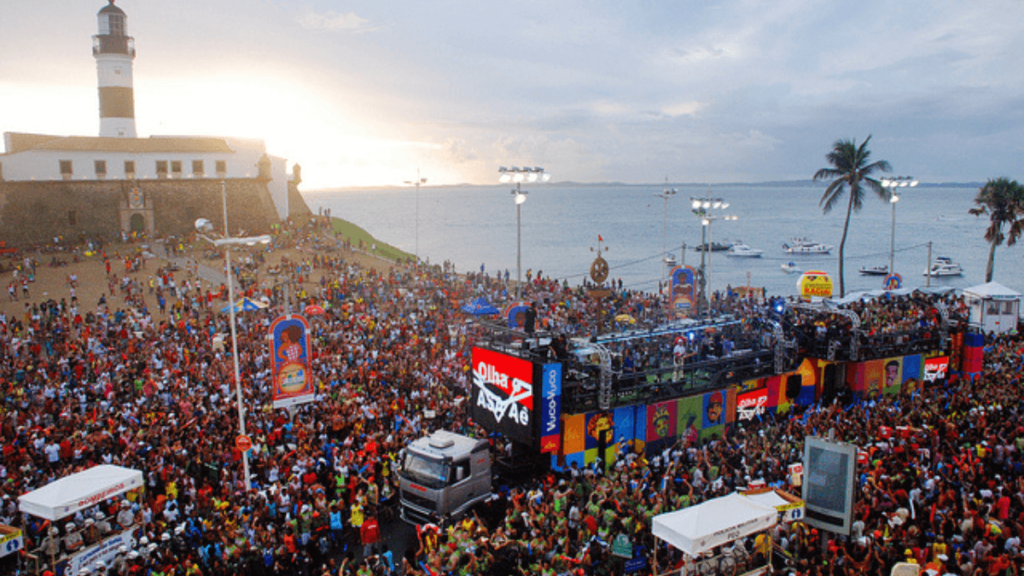
Salvador Carnival — 2 million people per day dancing through the streets behind trios elétricos in what is officially the world’s largest street party.
- The scale of participation is unmatched anywhere on Earth. 2 million people per day in the streets of one city, dancing to live music for six consecutive days. Nothing Rio offers comes close to this as a participatory experience.
- The music — axé — is Salvador’s own creation. You cannot hear this music the same way anywhere else. Ivete Sangalo, Bell Marques, Chiclete com Banana performing live on a trio elétrico surrounded by hundreds of thousands of people is a singular experience.
- The Afro-Brazilian cultural roots are more immediately present. Candomblé rhythms, African-derived traditions, and the heritage of Bahian culture are woven into every aspect of Salvador Carnival in a way that’s less visible in Rio.
- More affordable at the entry level. The pipoca (free zone) costs nothing. A week in Salvador Carnival can be done on a fraction of the budget required for an equivalent Rio experience.
- Regulars who have done both often prefer Salvador. The most experienced Brazil travelers — those who have attended Carnival multiple times — tend to gravitate toward Salvador as the deeper, more overwhelming, more distinctly Brazilian experience.
Which Is Right for You?
Can You Do Both?
Technically yes — Salvador Carnival runs February 5–10 and Rio runs the same dates. You cannot do both in the same year during the main Carnival week.
What some visitors do is attend the pre-Carnival blocos in Rio (which start weeks before the official dates) and then fly to Salvador for the main week — or vice versa. This requires planning and adds cost but gives you a taste of both cities in the same trip.
The more sustainable approach is to do one properly in 2027 and plan the other for 2028. Carnival deserves a full week in each city — not a rushed half-experience in both.
Honest Verdict
If this is your first Carnival and you’re not sure what you want, go to Rio. The format is more legible, the city is easier to navigate for first-timers, and the Sambadrome experience is genuinely extraordinary. You will not be disappointed.
If you’ve been to Rio Carnival, or if you specifically want the most intense participatory street party experience available anywhere in the world, go to Salvador. Most people who attend Salvador Carnival consider it the more overwhelming and ultimately more unforgettable of the two.
Recife and Olinda are the third option that most international visitors overlook — significantly more affordable than either Rio or Salvador, genuinely distinctive in its Northeastern cultural identity, and worth considering for anyone who wants a Carnival that feels less internationally famous and more authentically Brazilian.
Ready to plan your Carnival trip? Our complete guide covers all four cities with dates, tickets, accommodation, and costs.
Carnival Brazil 2027 — Complete Guide →