
New Year’s Eve Copacabana 2026 — Complete Guide to Rio’s Réveillon
Every December 31st, more than 2.5 million people in white converge on Copacabana Beach for what is widely considered the world’s largest New Year’s Eve celebration. Nineteen barges offshore launch fireworks for nearly 15 minutes at midnight, live stages run all night, and the entire city stops. This guide covers everything you need to plan the experience properly.
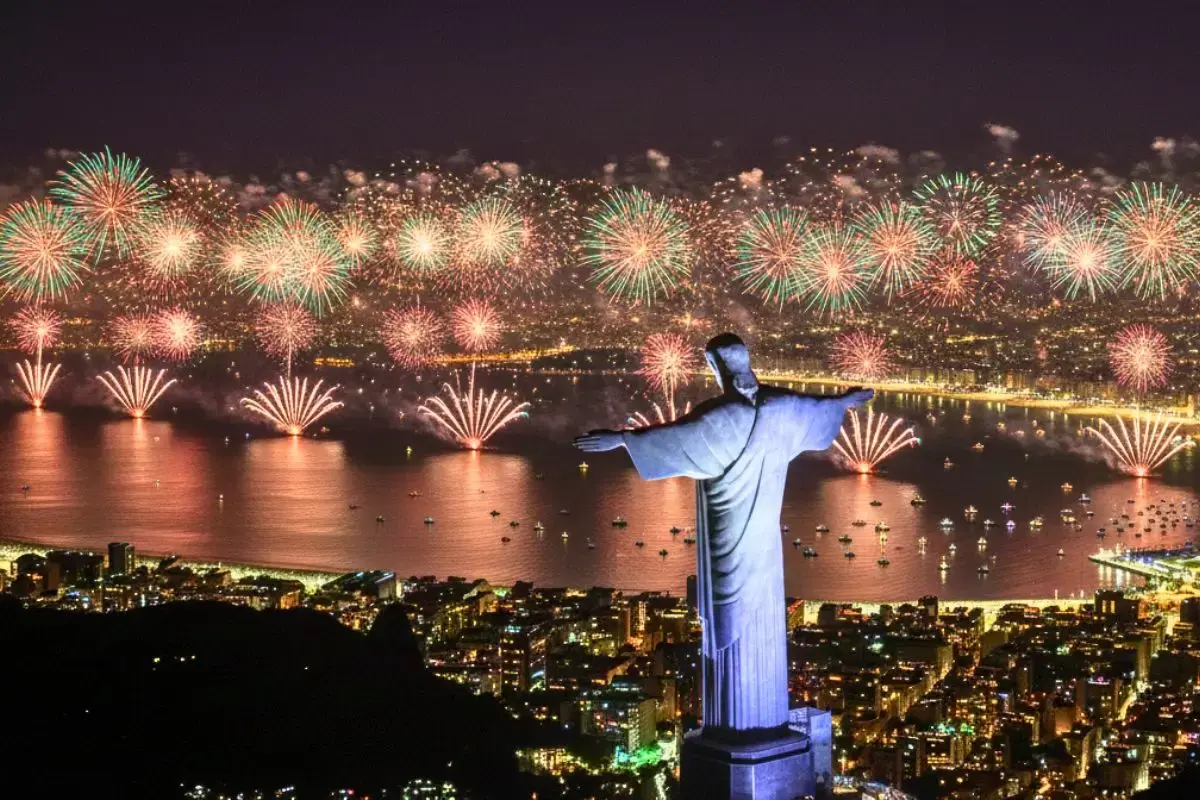
The midnight fireworks at Copacabana — launched from 19 barges anchored offshore, synchronized with music, and visible from the entire 4km stretch of beach.
What Is Réveillon?
Réveillon (pronounced “heh-veh-YONG”) is the Brazilian word for New Year’s Eve, borrowed from French. In Rio de Janeiro, it has evolved into something that bears little resemblance to New Year’s Eve anywhere else in the world. Over 2.5 million people gather on Copacabana Beach — locals and tourists, families and groups of friends, Cariocas and visitors from 100 countries — all in white, all on the same 4km stretch of sand, waiting for 19 barges to light up the sky over the Atlantic at midnight.
The fireworks last nearly 15 minutes. Live music stages are set up along the beach running from early evening through sunrise. The Candomblé tradition of wearing white — symbolizing Oxalá, the deity of peace and creation — means the entire crowd looks like a single organism when the midnight light hits.
It is free. There are no tickets for the beach. You simply show up in white and find your spot on the sand.
Key Facts
How the Night Unfolds
Arrive early — claim your spot
Locals begin arriving in the early afternoon to claim spots on the sand. Groups mark out areas with towels (cangas) and coolers. By 6pm the beach is already filling fast. If you want a good position in front of the main stage or near the barge alignment, arrive by 4–5pm.
Live music begins
Multiple stages along the 4km beach start their programming. Brazilian artists — samba, axé, funk, pagode, forró — perform continuously through the night. The 2026 lineup will be announced in December. Previous years have featured major Brazilian names like Ivete Sangalo, Anitta, and Jorge & Mateus.
Countdown builds
The energy on the beach intensifies significantly in the final hour. The crowd is at 2.5 million. White everywhere. The barges are visible offshore. The music stops for the countdown and the 2.5 million voices count down together — in Portuguese: dez, nove, oito, sete, seis, cinco, quatro, três, dois, um, FELIZ ANO NOVO!
The fireworks
Nineteen barges offshore launch simultaneously. The show lasts nearly 15 minutes — longer and more elaborate than most national fireworks displays. The first 3 minutes are the most intense. Don’t waste them filming — your phone won’t capture the scale and you’ll regret missing it live. Watch first, photograph after.
The party continues until dawn
The beach party continues through the night. Most stages run until 6am or later. Leaving immediately after the fireworks means fighting through the densest crowd of the evening — wait at least 45 minutes before attempting to exit. The metro resumes extended hours after midnight.
Where to Watch the Fireworks

Copacabana Beach on New Year’s Eve — 2.5 million people in white, with the 19-barge fireworks display visible from the entire 4km stretch of sand.
The original and the best. Standing on the sand with 2.5 million people at midnight, fireworks erupting from 19 barges directly in front of you, is the experience that brings people from 100 countries to Rio every December 31st. It’s free, chaotic, loud, and genuinely extraordinary. Arrive early to claim a spot in front of the main fireworks alignment.
The only spot in Rio where you can see the Copacabana, Botafogo, Flamengo, and downtown fireworks simultaneously — the entire city lighting up at once. Sugarloaf New Year’s tickets are among the most sought-after in Rio and sell out in October. If this is on your list, buy now.
Charter boats and party vessels anchor in Guanabara Bay with a privileged view of the Copacabana fireworks from offshore. Open bar, food, DJ, and the fireworks directly ahead of you. Prices range from R$500 for a basic boat to R$2,000+ for premium vessels. Book months in advance.
The historic fort at the southern end of Copacabana Beach hosts a paid New Year’s event with elevated views of both the beach crowd and the offshore barges. Less crowded than the open beach, with food and drink service. A good middle ground between the free beach and the premium hotel events.
Rooms facing the barges at Copacabana seafront hotels give you the fireworks from your own balcony — the crowd visible below, the barges directly ahead, and a private bathroom and hotel bar behind you. The most comfortable way to watch. These rooms book out 6+ months in advance and command significant premiums.
The White Dress Code
Wearing white on New Year’s Eve in Rio is not a suggestion — it’s a cultural tradition with roots in Afro-Brazilian Candomblé religion, where white symbolizes Oxalá, the deity of peace and creation. Every Carioca wears white on December 31st regardless of their religious beliefs. The tradition has been observed for generations and is one of the most visually striking aspects of the Réveillon.
Tourists who don’t wear white get noticed — not aggressively, but noticeably. Tourists who do wear white feel immediately part of the crowd. Head to toe white is the standard. Some people add gold accents for luck. Red is for passion, yellow for money — but white is non-negotiable for the beach.
Free vs Paid — What Needs a Ticket?
The beach is completely free. No tickets, no wristbands, no registration. You walk onto Copacabana Beach and that’s it. This is how 2 million Brazilians experience Réveillon every year.
Paid options exist for people who want comfort, better views, or a more organized experience:
| Option | Price range | What’s included |
|---|---|---|
| Copacabana Beach (free) | Free | Fireworks, live music, the full crowd experience |
| Sugarloaf Mountain event | R$400–800+ | Panoramic view, drinks, food, sell out in October |
| Boat party (Guanabara Bay) | R$500–2,000+ | Open bar, food, DJ, offshore fireworks view |
| Hotel rooftop party | R$600–3,000+ | Varies — typically open bar, dinner, view |
| Forte de Copacabana event | R$300–600 | Elevated view, less crowded, food & drink service |
Where to Stay
Accommodation in Copacabana and Ipanema for New Year’s Eve sells out months in advance — some properties book out in June or July for December 31st. If you haven’t booked, do it now.
Copacabana seafront is the most convenient location — walking distance to the beach, metro access, and the option of an ocean-view room with direct barge visibility. The Belmond Copacabana Palace, Sofitel Rio, JW Marriott, and Fairmont Rio are the most sought-after properties for Réveillon. Mid-range options on streets parallel to the beach (1–2 blocks back) are significantly cheaper with the same access.
Ipanema is 15–20 minutes on foot from the main fireworks zone — a good alternative if Copacabana hotels are sold out or over budget. The walk along the beachfront to Copacabana on the night is part of the experience.
Botafogo offers the best value — 30–40% cheaper than Copacabana with metro access. The metro runs extended hours on New Year’s Eve.
Getting There & Getting Back
Getting there: The metro is the only reliable option on New Year’s Eve. Uber and taxis stop working in Copacabana from around 4pm when streets close to traffic. The metro runs extended hours and connects to Copacabana via Cantagalo, Siqueira Campos, and Cardeal Arcoverde stations. Buy a Giro card or rechargeable ticket in advance to skip queues on the night.
Getting back: The metro resumes after midnight and runs continuously through the night and into New Year’s Day morning. The queue at metro stations immediately after the fireworks is enormous — wait at least 45–60 minutes before attempting to leave. Use the time to watch the post-midnight stages or sit on the beach. By 2am, the queues are significantly shorter.
Safety
Réveillon on Copacabana Beach is a massive crowd event and requires the same precautions as any dense public gathering in Brazil. The city deploys significant police presence for New Year’s Eve, particularly along the beach and metro stations.
- Carry nothing valuable. No watch, no jewelry, no wallet beyond the cash you need for the night. A money belt under your white shirt with R$100–200 for drinks and transport is all you need.
- Don’t use your phone openly in the crowd. Phone theft in dense New Year’s Eve crowds is the most reported crime against tourists. Use it briefly for photos and keep it in a front pocket or hidden bag.
- Stay with your group. Agree on a meeting point before entering the beach in case of separation. The crowd at 2.5 million is disorienting.
- Hydrate. 35°C, humidity, hours of standing. Dehydration is common. Bring water or buy from vendors. Don’t rely only on beer.
- Watch your drinks. Don’t accept drinks from strangers.
- Return to your hotel by metro or on foot. Don’t wait for Uber in peripheral areas after the fireworks — it won’t come. Walk if you’re in Copacabana or use the metro.
How Much Does Réveillon Cost?
| Category | Budget | Mid-range | Premium |
|---|---|---|---|
| Accommodation (3 nights) | $150–250 (hostel) | $600–1,200 | $1,500–4,000+ |
| New Year’s event | Free (beach) | R$400–800 (Sugarloaf/boat) | R$1,500–3,000+ (hotel party) |
| Food & drinks | $30–50 | $80–150 | Included in premium events |
| Transport | $10–20 (metro) | $20–40 | $50–100+ |
| Total (excl. flights) | $200–320 | $800–1,600 | $2,500–6,000+ |
Essential Tips
- Book accommodation now. Copacabana New Year’s Eve hotels sell out in July or August. If you’re reading this in July 2026, the best options are already going.
- Wear white. All of it. You will feel strange without it and every photo you take will show you as the one person not following the tradition.
- Don’t watch the first 3 minutes through your phone screen. The opening of the fireworks show is the most intense part. Watch it live. Photograph afterward.
- Arrive on the beach by 5–6pm for a good spot. The best positions fill up in the afternoon. Bring a canga (sarong) to mark your spot and food for the long wait.
- Don’t leave immediately after the fireworks. Wait 45–60 minutes. The crowd thins significantly and the metro becomes manageable.
- The free beach experience is the real experience. Hotel rooftop parties and boat events are comfortable but they separate you from the 2.5 million people on the sand. Most people who’ve done both prefer the beach.
- Sugarloaf tickets sell out in October. If that’s your plan, buy now — not in November or December.
- Fly into Rio at least 2 days before December 31st. Flight disruptions around New Year’s are common. Arriving December 29th gives you a buffer and time to enjoy Rio before the main event.
Planning the rest of your Rio trip? Our complete Rio de Janeiro travel guide covers everything from Christ the Redeemer to the best neighborhoods and beaches.
Rio de Janeiro Travel Guide →