
Getting Around Brazil
Brazil is the size of a continent, so getting around means picking the right mix of flights, buses, and local transport for each leg of your trip. Here’s how Brazilians and experienced travelers actually do it — not the idealized version, the practical one.

Long-distance bus terminals like this one in Belo Horizonte handle a huge share of Brazil’s domestic travel — still the backbone of getting around for most Brazilians.
The first thing to understand about transport in Brazil is scale. The distance between Rio de Janeiro and Manaus is longer than the distance between London and Moscow. That single fact shapes almost every decision you’ll make — long overland trips that look reasonable on a map can eat two full days, and a flight that costs more than a bus ticket often saves you that time back.
Most travelers end up combining all four options below depending on the leg: flights for the long jumps between regions, buses for shorter hops within the same region, ride-hailing and metro for getting around inside a city, and a rental car only for specific situations like coastal road trips.
Domestic Flights
For anything over roughly 600 km, flying is usually the better call. Brazil’s domestic network is dense and three airlines control nearly all of it — LATAM, GOL, and Azul. Between them you can reach almost any city with an airport, including smaller towns that would otherwise take a full day by bus.
LATAM has the widest network and tends to be strongest on routes connecting major hubs to international gateways. GOL runs a leaner, mostly Boeing 737 operation concentrated on high-traffic corridors like Rio–São Paulo. Azul specializes in regional and secondary airports, which makes it the most useful option if you’re heading somewhere off the main tourist circuit, particularly in the North and Northeast.
Booking domestic flights
Prices swing hard depending on how far ahead you book. A Rio–Salvador flight booked two months out might run $60–90, while the same route booked three days before departure can hit $200 or more. Use each airline’s own site (set to English) or a comparison tool to check all three at once before committing.
One quirk worth knowing: airline websites sometimes show different prices depending on whether you select Brazil or another country as your location, even in the same currency. It’s worth checking both before paying.
Airports to know
Several major cities have two airports, and which one you land at matters. Rio has Galeão (international, farther from the center) and Santos Dumont (domestic, walking distance from downtown and Centro). São Paulo has Guarulhos (international) and Congonhas (domestic, close to the city). If you’re flying domestically within Brazil, you’ll often land at the smaller, more central airport — factor that into your hotel choice.
Passenger rights (ANAC)
If your flight is delayed more than four hours or canceled, Brazil’s aviation authority (ANAC, under Resolution 400) requires the airline to provide meals, communication, and — if it stretches overnight — hotel accommodation and transport. Know this going in; it’s a real right, not a courtesy, and airlines don’t always offer it unprompted.
Interstate Buses
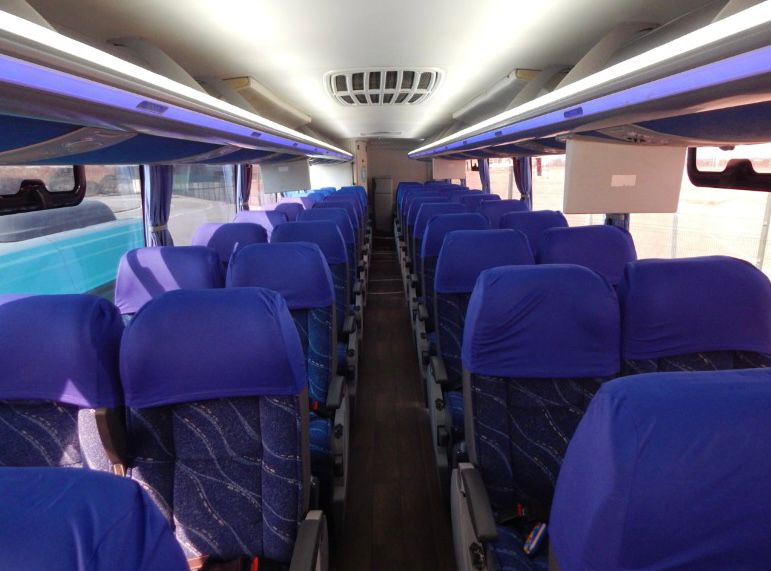
A reclining seat on a Brazilian intercity bus — comfort level depends heavily on the class you book.
For trips under 8–10 hours, especially within the same region, the bus is often the more practical option — and an overnight bus doubles as a hotel night, which keeps costs down. Brazil’s intercity bus network is large, well-organized, and used daily by both locals and travelers.
Bus classes
| Class | What to expect |
|---|---|
| Convencional | Basic reclining seat, A/C, the cheapest option — fine for short daytime trips |
| Executivo | Slightly more legroom and recline, often includes water and snacks |
| Semi-leito | Deeper recline, more padding — a reasonable middle ground for medium trips |
| Leito / Leito-cama | Reclines close to 180°, blanket and pillow included — built for overnight routes |
For any overnight trip, paying the extra for leito or leito-cama is worth it. The seats are on the lower deck, there are usually only 8–10 of them per bus, and they sell out first — book a few days ahead if you can.
Booking bus tickets
Major operators include Itapemirim, Cometa, Expresso Guanabara (strong in the North and Northeast), Águia Branca, and 1001. Coverage and quality vary by route, so check reviews for the specific company serving the leg you’re booking rather than assuming consistency across the brand.
What to expect at the terminal
Bus stations (rodoviárias) in major cities are generally well-policed and safe, though as with any transit hub, keep bags close and avoid flashing valuables. Buses typically stop every 3–4 hours at a rest area with food and bathrooms. Luggage goes in a checked compartment below — keep your documents, money, and electronics with you in the cabin.
Getting Around Within a City
Once you’ve arrived somewhere, local transport in Brazil mostly comes down to three options: ride-hailing apps, metro (where it exists), and city buses.
Uber and 99
Uber operates in every major Brazilian city and is the default choice for most travelers — it’s metered, traceable, and avoids language barriers or cash hassles. 99 is the local equivalent, owned by Didi, and is just as reliable in most cities; some travelers find it slightly cheaper. Both apps work the same way they do anywhere else.
Metro
São Paulo has Brazil’s most extensive metro system and it’s genuinely good — fast, clean, and a smart way to avoid the city’s notorious traffic. Rio’s metro is smaller but covers the main tourist corridor (Centro, Botafogo, Copacabana, Ipanema). Recife and Fortaleza have limited light rail or metro coverage. Outside these cities, metro generally isn’t a factor.
City buses
Local buses are the cheapest way to get around but require more local knowledge — routes aren’t always intuitive for visitors, and pickpocketing is more common on crowded city buses than on intercity coaches. If you’re comfortable navigating with a transit app like Moovit, they work fine. If not, ride-hailing is more predictable for short trips.
Renting a Car
A rental car makes sense in specific situations: road-tripping the coast (like the Rio–Paraty–São Paulo stretch, or around Florianópolis), reaching beaches without public transport, or covering several smaller towns in one region. It rarely makes sense as a way to get between major cities — distances are long, intercity driving conditions vary widely, and parking in city centers is its own headache.
Major international agencies (Localiza, Hertz, Avis, Movida) operate at all main airports. Localiza is Brazilian-owned and has the widest network, including smaller cities. Expect manual transmission to be the default; automatic cars cost more and need to be requested specifically.
What Makes Sense by Region
The right transport mix changes depending on where you’re headed:
Southeast
Rio, São Paulo, Minas Gerais — dense flight and bus network. Rio–São Paulo by bus takes 6–7 hours overnight; by air it’s under an hour. Both are reasonable depending on your schedule.
Northeast
Salvador, Recife, Fortaleza, João Pessoa — cities spread along the coast with real distances between them. Flying between the bigger hubs is usually worth it; shorter coastal hops work fine by bus or car.
South
Florianópolis, Porto Alegre, Curitiba — well-connected by both bus and air, with good road infrastructure if you want to drive between cities.
North
The Amazon region — this is where flying stops being optional. River and overland routes exist but can take days. Most travelers fly into Manaus and arrange river transport locally from there.
FAQ About Getting Around Brazil
Generally yes, especially with established companies booked through official channels. Buses check IDs for interstate routes, luggage is tagged, and many have GPS tracking. Keep valuables on your person rather than in checked luggage.
Either works well. The flight is under an hour and costs roughly $50–100 one-way; the overnight bus takes 6–7 hours and costs $40–70, while also saving you a night of accommodation.
Many local bus and even some flight booking sites ask for one. Airlines usually let foreign visitors book without it; some bus operators don’t. International booking platforms that accept foreign passports and cards are the workaround.
Only for specific legs — coastal road trips or reaching beach towns without bus service. For city-to-city travel, flights and buses are almost always more practical than driving.
Aim for at least 3–4 weeks out. Prices climb noticeably in the final week before departure, especially around holidays and Carnaval.