Best Time to Visit Lençóis Maranhenses
The best time to visit Lençóis Maranhenses depends entirely on one thing: the lagoons. They only exist after the rainy season fills them — visit at the wrong time and you find white dunes with no water between them. The window matters more here than at any other destination in Brazil.

Lençóis Maranhenses with full lagoons — this is what the park looks like between April and September, when rainfall fills the hollows between the dunes with freshwater.
Quick Answer
Best overall: June to September. The lagoons are at their fullest after the rainy season, the weather is dry and warm, and you get the combination of full blue water and white dunes that defines the park. July and August are the peak months — busiest and most expensive, but the best conditions.
Best for fewer crowds: May or October. The lagoons are still well-filled in May — the rains have just stopped and the water hasn’t had time to evaporate. October is the tail end of the good season with noticeably fewer visitors and lower prices than July or August.
Avoid if lagoons are the priority: November to February. The dry season drains the lagoons progressively. By December most interior lagoons are shallow or dry. The dunes are still dramatic — but it’s a very different experience from the postcard images.
Season Breakdown
Month by Month
Ready to plan the full trip? Our itinerary covers 4 days in Lençóis Maranhenses — Barreirinhas, Atins, the lagoon circuit, and the boat tour in the right order.
Lençóis Maranhenses Itinerary →Understanding Lagoon Water Levels

Full lagoons at sunset — the landscape Lençóis Maranhenses is known for, only possible between April and October after the rainy season has done its work.
The lagoons in Lençóis Maranhenses don’t come from underground springs or rivers. They form when rainwater collects in the hollows between the dunes during the rainy season (January to June) and stays there because the sand is compacted enough to hold it. As the dry season progresses, evaporation slowly drains them.
The rate of evaporation varies by lagoon. The deeper lagoons — Lagoa Azul, Lagoa Bonita — hold water longer into the dry season than smaller, shallower lagoons. In October, the main lagoons often still have enough water to swim in, but the smaller interior lagoons may already be dry.
This also means that the specific conditions you find depend on how much rain fell the previous season, not just the calendar month. A particularly wet rainy season means fuller lagoons that last longer into the dry season. A dry year means some lagoons barely form at all.
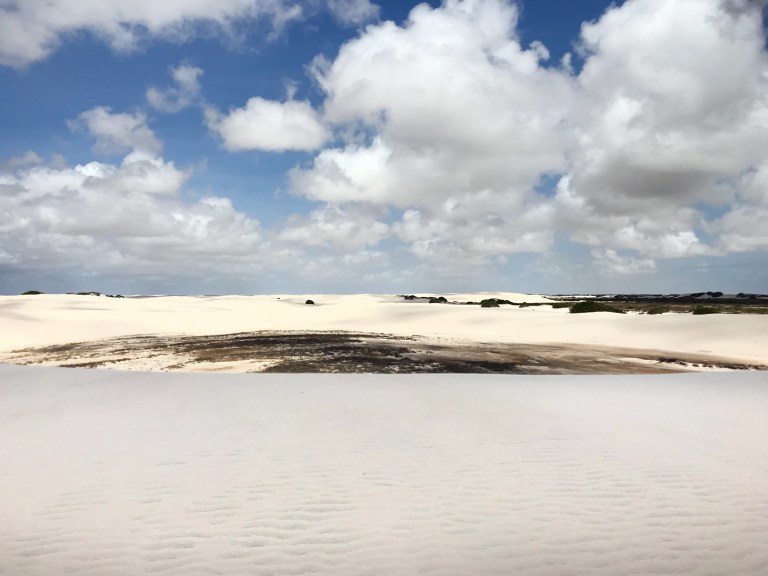
The same dune landscape in the dry season — without water in the lagoon hollows, the park looks completely different from its rainy season form.
Practical Tips
- July and August are the peak months — accommodation in Barreirinhas fills up and prices rise 30–50% above low season. Book 4–6 weeks ahead minimum for these months.
- May and September are the best value windows — the lagoons are still in good condition but the crowds and prices are significantly lower than peak season.
- The road from São Luís to Barreirinhas (BR-135) can be difficult in the heavy rains of March and April — some sections flood and transfer times increase significantly. Check road conditions if visiting in this period.
- The boat from Barreirinhas to Atins along the Rio Preguiças can be rougher and less reliable during and immediately after the rainy season — factor this in if Atins is part of your plan.
- Temperature in Lençóis Maranhenses is hot year-round — 28–35°C regardless of season. The rainy season brings humidity; the dry season brings intense reflected heat from the white sand. SPF 50+ is essential in both cases.
- Check current lagoon conditions with your pousada or tour operator before finalizing dates — they have real-time information about which lagoons are full and which are dry in any given week.