
How Much Does Florianópolis Cost?
Florianópolis is more expensive than most Brazilian cities — particularly in summer, when prices for accommodation can double or triple overnight. But it’s still very affordable by European or North American standards, and with the right approach you can manage costs without sacrificing the experience. Here’s what to actually expect.

Florianópolis is the priciest destination in this guide — but still affordable for international visitors, especially outside of peak summer season.
Daily Budget Summary
These figures cover accommodation, food, local transport, and basic activities per person per day. They don’t include flights or car rental, which is an additional fixed cost most visitors will have.
Hostel dorm, per-kilo lunches, cooking some meals, public transport where possible, free beaches.
Pousada or 3-star hotel, mix of restaurants and casual meals, rideshares, some paid activities.
Jurerê resort or beachfront hotel, good restaurants every night, private transfers, boat trips.
Accommodation
Florianópolis has more accommodation options than most cities its size — pousadas, boutique hotels, Airbnb houses, and international chain hotels. Prices below are per room per night in shoulder season. Add 50–100% for peak summer.
| Type | Details | Cost (USD) |
|---|---|---|
| Hostel dorm | 4–8 bed dorm, usually with breakfast, Lagoa or Centro | $14–22 |
| Budget private room | Simple guesthouse or pousada, private bathroom | $36–60 |
| Mid-range pousada | Comfortable pousada in Lagoa or south coast, breakfast included | $60–100 |
| 3-star hotel | Standard hotel, pool, A/C, usually with breakfast | $80–130 |
| Jurerê resort / 4-star | Beachfront or near-beach hotel in Jurerê, full facilities | $140–300 |
| Airbnb house (2-bed) | Self-catering house near Lagoa or south coast, good for groups | $80–160 |
Food and Drink
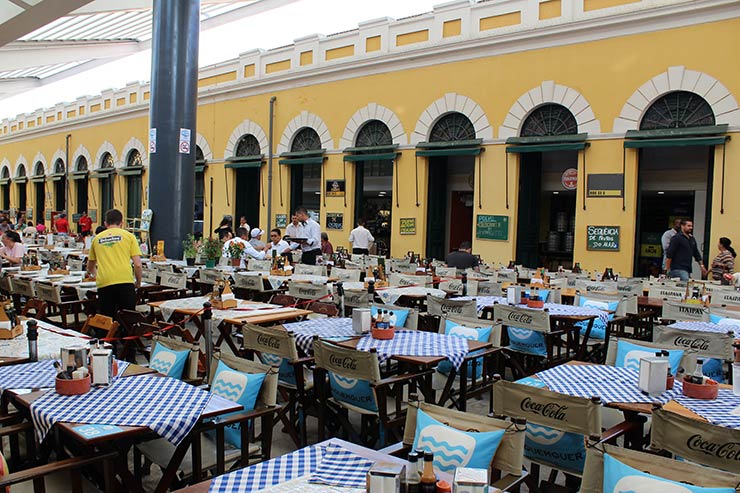
The Mercado Público is the best place in Florianópolis for cheap, high-quality food — oysters, fresh fish, and regional dishes at prices well below the beach restaurants.
Food in Florianópolis is more expensive than in Recife or Salvador but still excellent value by international standards. The island has a strong food culture rooted in Azorean immigration — fresh seafood, particularly oysters farmed in the surrounding bays, is the highlight and remarkably affordable.
Eating cheaply
The Mercado Público is the best budget option in the city. The ground floor bars serve fresh oysters for R$25–40 per dozen and cold beer from the early morning. It’s where locals eat and drink, not a tourist trap. A full lunch at a per-kilo restaurant anywhere on the island runs R$30–50 ($6–10 USD) for a generous plate.
Padarias (bakeries) are useful for cheap breakfasts — pão de queijo, coffee, and fresh bread cost R$15–20 total. Street food is less prevalent in Florianópolis than in Recife, but tapioca stands near the beaches run R$10–15 for a filled crepe.
Sit-down restaurants
A mid-range lunch or dinner at a proper restaurant runs R$70–130 per person ($14–26 USD) including a drink. Seafood restaurants are the standout — a full grilled fish or shrimp dish with sides runs R$60–100, and the quality justifies it. Beach kiosk food is typically 30–40% more expensive than equivalent restaurants one street back, for lower quality. Worth keeping in mind.
Oysters
Florianópolis produces some of the best oysters in Brazil — farmed in the clean, cold bays of the island’s north and east coast. A dozen at the Mercado Público costs R$25–40. At beach restaurants the same dozen can cost R$60–80. The quality at the market is at least as good. If you eat oysters, go to the Mercado.
| Item | Cost (BRL) | Cost (USD) |
|---|---|---|
| Per-kilo lunch (full plate) | R$30–50 | $6–10 |
| Dozen oysters (Mercado Público) | R$25–40 | $5–8 |
| Mid-range restaurant meal | R$70–130 | $14–26 |
| Grilled fish or shrimp dish | R$60–100 | $12–20 |
| Beer (600ml, bar) | R$10–18 | $2–3.60 |
| Coffee (padaria) | R$5–8 | $1–1.60 |
Transport

The SC-401 — the main north-south road of the island. In peak summer it’s the most congested road in Santa Catarina. Factor driving time into your daily plans.
Transport is where Florianópolis costs add up quickly. The island is large, public transport is limited, and a car is effectively essential for any serious exploration. Most visitors rent a car for their entire stay.
Car rental
The most important transport cost in Florianópolis. A basic compact car rents for R$120–200 per day ($24–40 USD) from agencies at the airport or in the center. Fuel runs around R$6 per liter. Over a week, budget R$800–1,400 total for car plus fuel depending on how much you drive. For two people splitting the cost, it’s the most practical option by a significant margin.
Rideshares
99 and Uber both operate. A trip within Lagoa da Conceição costs R$15–25. From Lagoa to Jurerê runs R$45–65. From the center to the south coast is R$35–55. Used daily across the island, rideshares add up to more than a rental car for most visitors. They work well for evenings out when you don’t want to drive.
Public transport
Buses exist and connect the center to most neighborhoods, but are slow, infrequent to some areas, and don’t reach the south coast well. A single journey costs R$4–6. Useful for the north coast beaches from the center, less useful for anything south of Lagoa.
| Journey / Item | Cost (BRL) | Cost (USD) |
|---|---|---|
| Car rental (per day, basic) | R$120–200 | $24–40 |
| Fuel (per liter) | R$6 | $1.20 |
| Rideshare within Lagoa | R$15–25 | $3–5 |
| Lagoa → Jurerê (rideshare) | R$45–65 | $9–13 |
| Centro → south coast (rideshare) | R$35–55 | $7–11 |
| Bus (single journey) | R$4–6 | $0.80–1.20 |
Activities

Most of what makes Florianópolis worth visiting is free — beaches, trails, and the lagoon. Paid activities are mostly water sports and boat trips.
Most of Florianópolis’s best experiences cost nothing. The beaches, the Lagoinha do Leste hike, Lagoa da Conceição, the Mercado Público, the historic center — all free. Paid activities are mostly water sports, boat trips, and a handful of entry fees.
| Activity | Cost (BRL) | Cost (USD) |
|---|---|---|
| Beaches, trails, lagoon | Free | Free |
| Sandboard rental (Joaquina dunes) | R$20–30/hr | $4–6/hr |
| Surf lesson (2 hours, group) | R$120–180 | $24–36 |
| Kitesurfing lesson (2 hours) | R$200–300 | $40–60 |
| Boat to Ilha do Campeche (return) | R$60–80 | $12–16 |
| Stand-up paddle rental (1 hour) | R$40–60 | $8–12 |
| Beach chair rental (full day) | R$20–40 | $4–8 |
Money and Payments
Cards are widely accepted in Florianópolis — more so than in Recife or Salvador. Most restaurants, hotels, and shops in the main tourist areas take credit and debit cards without issue. Contactless payment is common. That said, cash is still useful for markets, smaller beach kiosks, parking, and the informal boat trips to Ilha do Campeche.
ATMs are available throughout the island — inside supermarkets, shopping centers, and bank branches. The most reliable for international cards are Bradesco, Itaú, and Banco do Brasil. Avoid street ATMs at night. Daily withdrawal limits of R$500–1,000 apply at some machines.
A Wise or Revolut card is the most cost-effective way to spend in Brazil. Both offer real exchange rates with minimal fees and work reliably at Brazilian ATMs and card terminals.